

Maria Znamenska
Associate Professor of Ophthalmology, Retina Imaging Expert
Reading time
9 min.
Highlights: AI in optometry is revolutionizing clinical decision-making by allowing eye care professionals to analyse B-scans with greater precision, consistency, and confidence right at the point of care.
- AI for fundus analysis is another way to automatically evaluate fundus scans in an optimized way throughout all devices.
- AI-driven deep learning algorithms can detect and quantify retinal and optic nerve pathologies in OCT images, enabling earlier identification of diseases such as glaucoma, age-related macular degeneration (AMD), and other retinal conditions.
- AI-assisted analysis enhances clinical efficiency by helping clinicians triage scans, monitor disease progression over time, and focus on clinically significant findings, rather than relying solely on manual scan reviews.
- Other AI-powered tools provide objective visual insights for clinicians and patients, improving the accuracy of triage and treatment monitoring and enhancing patients’ understanding of retinal health.
- AI enables optometrists to manage more complex ocular cases in primary care, facilitating earlier detection, risk stratification, and informed referral decisions based on objective insights.
- AI chatbots in optometry inform about eye symptoms, guide whether to seek care (urgent vs. routine), suggest possible conditions, support patients and help decide next steps, etc. Or manage eye care specialists’ daily routine.
Introduction
Artificial intelligence is increasingly shaping healthcare by enhancing clinicians’ ability to interpret complex medical data and make earlier, more informed decisions. AI in optometry is especially important in OCT imaging, where it is essential to correctly interpret subtle structural changes to identify eye disorders early.
AI for optometrists can therefore more reliably and consistently detect and track retinal and optic nerve disorders by integrating deep learning into OCT data. In routine optometric practice, risk management and referral decision-making are enhanced by converting OCT images into understandable, actionable findings.
Discover how optometry AI tools redefine optometry by improving diagnostic accuracy, clinical efficiency, and the quality of patient care in 5 real cases.
1. AI Decision Support for OCT Analysis
One of the most effective AI applications in optometry is AI decision support for OCT analysis.
AI decision-support systems are increasingly applied to OCT imaging to assist optometrists in interpreting complex retinal and optic nerve data. Here’s one of the real cases when AI brings ultimate use to practitioners:
Thus, AI-powered platforms like Altris use deep learning algorithms to automatically detect and quantify structural changes, highlight areas of concern, and track progression over time via an AI OCT pathology detection tool.
By analysing patterns across large datasets of retinal scans, the system can flag subtle abnormalities that may be difficult to identify manually, segment them automatically, and provide structured, visual insights that help clinicians make more informed, consistent decisions while monitoring patient eye health. It does everything eye care specialists do, but faster, error-free, and unbiased.
In particular, Altris AI also applies deep learning to OCT scans to automatically detect and highlight complex retinal and optic nerve changes.
The system quantifies abnormalities, tracks progression over time, and provides visual insights that help optometrists interpret scans more accurately and consistently, again supporting far more informed clinical decisions.
2. AI for Fundus Analysis
AI for Fundus Analysis is another way to automatically evaluate fundus scans in an optimized way throughout all OCT devices. Among the top 3 AI software solutions for fundus imaging, there are:
Auroraa AI (Optomed) is an advanced artificial intelligence platform integrated with Optomed’s handheld and tabletop fundus cameras, designed to detect multiple retinal abnormalities including diabetic retinopathy, glaucoma, and age‑related macular degeneration; it provides immediate, automated screening results to support clinicians and improve early disease detection.
Beammed’s AI‑powered fundus cameras pair intelligent image analysis with portable retinal imaging to enable early detection of diabetic retinopathy and other retinal conditions, leveraging deep learning algorithms to highlight pathology and help streamline screening programs.
Cybersight AI (Orbis) offers an AI‑driven diagnostic support tool focused on interpreting fundus images to assist eye care providers in low‑resource settings and telemedicine programs, combining machine learning with expert clinical guidance to improve access to retinal disease screening globally. Here’s how fundus tool may look like:
Such systems provide severity scores, highlight areas of concern, and track changes over time, giving clinicians objective, reproducible insights to support their decisions. Since AI can detect early signs of conditions like glaucoma, diabetic retinopathy, and age-related macular degeneration, it often spots subtle changes that are hard to see with the naked eye.
3. AI for Automated Visit Scheduling
AI‑powered appointment scheduling systems are digital tools that, alongside any modern AI OCT pathology detection tool or similar, use artificial intelligence — including natural language processing (NLP), predictive analytics, machine learning, and automated communication — to handle clinical scheduling tasks usually done manually by staff. These tools can:
- let patients self‑schedule online, by chat, voice, or text at any time,
- automatically confirm, remind, reschedule, or cancel appointments,
- optimize schedules based on provider availability and patient needs, and
- predict and prevent clinic inefficiencies such as no‑shows.
In essence, the system acts as a digital receptionist and smart scheduler, integrating with clinic practice management software, EHRs, and CRM systems to manage workflows seamlessly. Best EHR systems include:
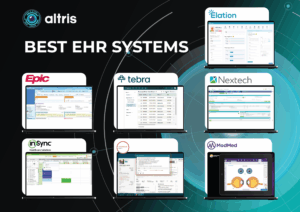
Elation EHR is a cloud-based electronic health record designed primarily for independent primary care practices. It focuses on simplifying clinical workflows, documentation, and patient engagement, with strong charting tools and longitudinal patient records. It’s used to help physicians deliver personalized care while reducing administrative burden.
Epic is one of the most widely used enterprise EHR systems globally, typically implemented by large hospitals and health systems. It integrates clinical, administrative, and billing functions into a single platform, supporting everything from patient records to population health management. It’s used to coordinate care at scale and improve interoperability across departments and organizations.
Tebra combines electronic health records with practice management, billing, and patient communication tools, targeting small to mid-sized medical practices. It streamlines front-office and clinical operations in one system, helping practices manage scheduling, documentation, and revenue cycle efficiently.
Nextech EHR is a specialty-focused EHR designed for fields like ophthalmology, dermatology, and plastic surgery. It includes tailored templates, imaging integration, and workflow tools specific to these specialties. It’s used to enhance clinical efficiency and documentation accuracy in specialized practices.
InSync EHR is a cloud-based EHR built for behavioral health and therapy practices. It supports telehealth, scheduling, documentation, and billing, with features tailored to mental health workflows. It’s used to improve care coordination and streamline operations for therapists and behavioral health providers.
These tools are designed to improve operational efficiency, reduce administrative burden, and enhance the patient journey in healthcare settings. They offer 24/7 availability, personalized booking flows, and real-time updates, making them a powerful part of your workflow.
ModMed EMA (Electronic Medical Assistant) is an AI-driven, specialty-specific EHR developed by Modernizing Medicine. It uses structured data and adaptive templates to support clinical decision-making and documentation. It’s used by specialists to increase efficiency, improve outcomes, and reduce time spent on manual data entry.
“Up to 71% of U.S. hospitals now use predictive AI technologies for scheduling and related automation.”
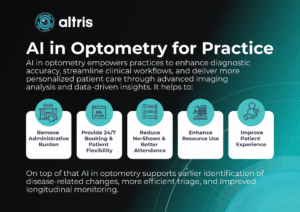
Indeed, AI in optometry for appointments, self-scheduling, and other administrative tasks can optimize routine workflows and offer a range of benefits for both opticians and their visitors. They:
- Remove Administrative Burden
AI takes over repetitive scheduling tasks — booking, confirmations, cancellations, preregistration, and follow‑ups — freeing front‑desk staff and nurses to focus on patient care rather than paperwork.
Historically, nurse managers and front‑desk staff can spend up to 40% of their day on scheduling tasks, and automating this saves hours of labour.
- Provide 24/7 Booking & Patient Flexibility
Patients no longer have to call during office hours. AI scheduling tools enable self‑service booking, changes, and cancellations at any time via chatbots, voice interfaces, or online portals.
This has become especially crucial, as 40% of healthcare appointments are requested outside normal business hours — times when traditional phone booking is impossible.
- Reduce No‑Shows & Better Attendance
Automated reminders — via SMS, email, or voice — consistently reduce no‑show rates, which can otherwise waste clinic time and revenue. Clinics using these tools have reported:
-
No‑shows dropped from 20% to as low as 7% with automated reminders.
-
In some settings, AI virtual assistants reduced missed visits by up to ~73%.
AI can also predict patients likely to skip visits and prompt engagement before issues arise.
- Enhance Resource Use
Instead of manually guessing who should be booked and where, such AI in optometry:
✔ matches patients with the right clinician,
✔ avoids double bookings and schedule conflicts,
✔ spreads appointments evenly to reduce bottlenecks, and
✔ improves utilization of staff time and rooms.
AI scheduling can increase provider utilization by 15–25% and reduce wait times by 15–30%.
- Improve Patient Experience
Patients appreciate convenience. Access to online or chatbot booking correlates with improved satisfaction — one study showed satisfaction scores can rise by over 20% when patients can self‑manage appointments.
AI also reduces inbound phone volume by 25–40%, allowing clinics to serve patients more efficiently.
For instance, Tele-optometry decision support that offers
- AI pre-analyses remote exams
- Flags cases requiring in-person referral
- Supports non-specialist reviewers
has the following workflow impact:
- Scales remote care
- Consistent quality
- Faster review cycles
Used in:
- Large optometry chains
- Retail vision centres
- Franchise-based practices
- Rural clinics
- Community health centres
- Mobile eye clinics, etc.
4. AI Workflow & Practice Optimization
So, AI-assisted OCT analysis has become helpful in retina & glaucoma screening, in follow-ups, progression tracking, and other workflows. Meaning, what happens with OCT with the help of an AI OCT pathology detection tool is helpful in many ways:
- OCT scans are automatically analysed
- Pathologies are flagged (fluid, thinning, progression risk, etc.)
- Clinicians review AI output before raw scans.
So, they get
- Faster exam review
- Fewer missed subtle findings
- Consistent interpretation across doctors, etc.
But real-world AI applications in optometry for clinic management do not stop there: scheduling, reminders, patient triage, administrative automation, analytics, and beyond may also be supported by specific optometry AI tools. Here are a few examples.
AI triage tools for urgent eye issues
- AI pre-screens OCT/fundus images
- Exams are auto-prioritized by severity
- High-risk patients are flagged before the visit
Workflow impact:
- Smarter scheduling
- Faster routing to specialists
- Less cognitive load on staff
Used in:
- High-volume optometry chains
- Tele-optometry services
An example of AI diagnostic software for optometry and ophthalmology can be IDx-DR AI Diagnostic System for Detecting Diabetic Retinopathy.
Automated appointment reminders
Automated appointment reminders are AI- or rules-based systems, not yet independent chatbots or AI assistants, that automatically notify patients about upcoming eye exams via SMS, email, WhatsApp, or voice calls, without staff involvement.
They usually trigger:
- 7 days before (prep + reschedule window)
- 48–72 hours before (confirmation)
- 24 hours or same day (final reminder)
which makes them still a new generation of automation tools for eye care. Well-designed systems, like the majority of AI in optometry tools, support:
- HIPAA / GDPR-compliant messaging
- No clinical advice in reminders
- Audit logs of sent communications
- Opt-out controls
This makes them safe for both routine and medical eye care appointments.
For example: EyeCloudPro
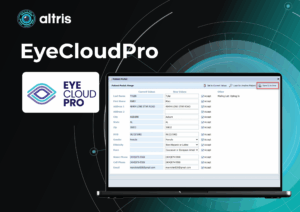
But why do no-shows happen in optometry? Like in any other service sphere, there are real reasons why:
- Routine exams feel “non-urgent.”
- Long booking lead times (2–6 weeks)
- Patients forget dilation/prep requirements
- Elderly patients miss calls or misremember dates
- Parents forget pediatric appointments
- No easy way to confirm or reschedule
Across outpatient care (including optometry), automated reminders typically achieve:
- 20–40% reduction in no-shows
- 5–10% increase in appointment confirmations
- Up to 30% fewer last-minute cancellations
- 1–2 hours/day staff time saved (no manual calls)
In optometry specifically, clinics with long routine exam cycles often see results closer to the upper end of those ranges. What automated reminders do here is directly target forgetfulness + reduce friction. No ordinary staff can do that to such an extent. But AI can.
Therefore, by keeping patients aware, ready, and involved, automated appointment reminders help optometry clinics reduce no-show rates. Practices may increase patient flow, maximize chair time, and enhance attendance by providing timely, customized notifications through preferred channels—all without adding to the administrative burden.
Patient communication and optometrists’ education apps
Patient communication, as well as optometrist education systems and applications, for mobile and desktop usage, support clearer understanding, better engagement, and more consistent care delivery.
For example: Chatbots in Healthcare from Capacity

These tools help patients understand their eye health and treatment plans, while enabling optometrists to stay informed through structured education, clinical updates, and decision-support resources—improving outcomes without increasing chair time:
- AI translates OCT findings into plain language
- Visual overlays show “what changed” and “why it matters.”
- Used chairside or via patient portal
Workflow impact:
- Better patient understanding
- Higher treatment acceptance
- Shorter explanation time per visit
Used in
- Routine eye exams
- OCT review appointments
- Retina & glaucoma visits
- Anti-VEGF treatment discussions
- Glaucoma therapy initiation
- Long-term monitoring plans, etc.
Altris Education application, as an example of a unique tool specifically designed for eye care specialists’ training:
5. Chatbots for Consultation
A separate category is AI chatbots and virtual assistants that help with patient follow-up, education, and communication, improving day-to-day patient communication and more. With the AI Help Assistant feature, you can create an AI chatbot trained on your specific content from any platform you like. Chatbots for consultation in optometry offer clear, practical benefits for both clinics and patients:
- 24/7 Q&A
- Absolutely personalized follow-up instructions
- Higher patients satisfaction rate
Furthermore, they provide instant, 24/7 responses to the most common eye-care questions, helping patients understand symptoms, prepare for visits, and follow post-exam instructions without even waiting for staff availability.
Chatbots can assist with pre-consultation triage by gathering symptoms, visual complaints, and medical history, allowing optometrists to focus on higher-value clinical tasks.
They also improve patient engagement and adherence by delivering personalized education, reminders, and care instructions in simple, easy-to-understand language.
Overall, optometry chatbots dramatically reduce administrative workload, shorten response times, and support more efficient, patient-centered care while maintaining consistent communication quality.
Types of Chatbots in Eye Care & Optometry
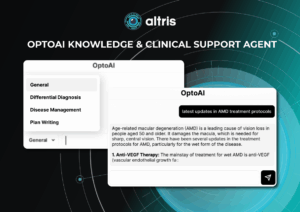
1. Symptom & Triage Chatbots
These ask users about eye symptoms, guide whether to seek care (urgent vs. routine), suggest possible conditions, and help decide next steps. Example: Ada Health
A study published in Eye showed that large‑language‑model‑based chatbots (e.g., ChatGPT) could answer common ophthalmology questions with high accuracy and clarity — scoring higher than alternative generative models for diagnostic and triage‑related queries (accuracy and comprehensiveness metrics showed ChatGPT did well on standard patient questions).
Another clinical evaluation found that AI (GPT‑4) correctly identified the appropriate diagnosis among the top three options in up to 93% of ophthalmology cases and correctly assessed urgency levels in most cases — performance comparable to that of trainees.
2. Real‑World Chatbots for Eye Care
The patient describes eye symptoms and uploads images (e.g., photos or OCT scans).
An AI assistant organizes symptoms and images for review, then a real ophthalmologist chats with the patient to guide care. Key inputs here:
- Collect symptoms in natural language
- Translate or clarify reports
- Help the clinician interpret visuals and decide next steps
It combines AI symptom intake with real human consultation, making remote triage efficient.
AI in optometry real chatbot examples:
- WebEyeClinic / Visio — symptom intake & remote clinician chat
- VisionCare Assistant — eye health guidance
- DocsBot AI — practice support
- Custom AI agents via Voiceflow — administrative automation, etc.
3. DocsBot AI for Optometry Services
Practice‑focused chatbot helping clinics answer FAQs, provide pre‑appointment instructions, and automate patient engagement. Benefits:
• Instant responses to common patient queries
• 24/7 availability for basic information
• Can free up staff time by handling routine communication, such as allowing self-booking, etc.
“Patients express high satisfaction with AI self‑booking capabilities (up to 85% positive ratings).”
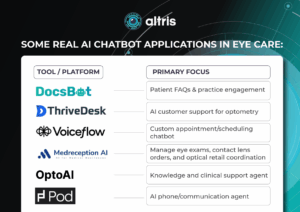
Here are some more real AI chatbot applications in eye care:
| Tool / Platform | Primary Focus |
| DocsBot AI | Patient FAQs & practice engagement |
| ThriveDesk AI | AI customer support for optometry |
| Voiceflow AI Agent | Custom appointment/scheduling chatbot |
| MedReception AI | Manage eye exams, contact lens orders, and optical retail coordination |
| OptoAI AI Assistant | Knowledge and clinical support agent |
| Pod AI | AI phone/communication agent |
As highlighted, there is a wide array of chatbot types in optometry, ranging from patient-facing virtual assistants to AI-powered communication platforms.
With features such as automated appointment scheduling, pre-visit coaching, FAQ handling, 24/7 patient engagement, and basic clinical decision support, these optometry AI systems offer substantial value.
By streamlining administrative tasks and improving patient education, these AI chatbots free up clinicians’ time to focus on direct care.
Overall, the integration of AI-driven chatbots is revolutionizing the delivery of eye care. They enhance operational efficiency, reduce missed appointments, support timely patient triage, and improve adherence to care plans. By combining automation with intelligent decision support, AI not only optimizes clinic workflows but also elevates patient outcomes and satisfaction, marking a transformative shift in modern optometry practice.
Conclusion
AI is rapidly becoming a practical and valuable tool in optometry, particularly for analysing OCT imaging. By enabling more consistent interpretation of complex retinal and optic nerve data, AI in optometry supports earlier identification of disease-related changes, more efficient triage, and improved longitudinal monitoring.
Beyond clinical efficiency, AI enhances patient communication by translating OCT findings into clear visual insights, supporting better understanding and engagement. As a result, optometrists are better equipped to manage more complex cases in primary care, make informed referral decisions, and deliver higher-quality, data-informed eye care—positioning AI as a meaningful complement to clinical expertise rather than a replacement.
FAQs
Is AI for optometry safe?
AI in optometry is generally safe when it is properly validated, regulated, and used as a clinical support tool rather than a replacement for professional judgment. It can improve screening accuracy, enable earlier detection of eye diseases, and streamline workflows, but it also carries risks such as diagnostic errors, data privacy concerns, and bias if systems are poorly trained or over-relied upon. For safe use, optometrists must remain responsible for final decisions; patients should be informed when AI is involved; and tools should comply with medical regulations (such as FDA or CE approval) and data protection standards, such as GDPR or similar, depending on the region.
What’s an AI OCT pathology detection tool?
An AI OCT pathology detection tool is a software system that uses artificial intelligence to analyse optical coherence tomography (OCT) images of the eye and automatically identify signs of disease, such as macular degeneration, glaucoma, or diabetic retinopathy; it assists clinicians by highlighting abnormalities and suggesting potential diagnoses, but it is designed to support—rather than replace—professional interpretation, and its safety and effectiveness depend on proper validation, regulatory approval, and clinician oversight.
Can AI help reduce no-shows and long wait times in an optometry practice?
Yes. AI applications in optometry are limitless. AI can help reduce no-shows and long wait times in optometry practices by supporting appointment scheduling, reminders, and workflow optimization—such as identifying scheduling patterns, highlighting bottlenecks, and enabling more efficient patient flow—while assisting staff with better resource planning and communication.
What can chatbots and AI assistants do for an optometry practice?
Chatbots and AI assistants can help an optometry practice automate patient communication, streamline scheduling, and improve clinical efficiency by answering FAQs 24/7, booking and confirming appointments, sending reminders, pre-screening patients with symptom checkers, collecting medical history before visits, and triaging urgent cases. They can also support front-desk staff by handling insurance questions, guiding patients to the right services (e.g., OCT, glaucoma screening, contact lens exams), following up after visits, and reactivating inactive patients through personalized messaging. Internally, AI in optometry assistants can summarize patient data, flag high-risk cases, analyse trends in no-shows or referrals, and help with marketing automation — ultimately reducing administrative workload, improving patient satisfaction, and increasing practice revenue.
What kinds of clinical or diagnostic support can AI provide in eye exams?
AI can support eye exams by assisting with image review, pattern recognition, and data organization—such as highlighting features in retinal images, supporting consistency in exam review, and providing quantitative reference information—while remaining a complement to clinician judgment rather than a replacement for clinical decision-making.
How can AI increase optical revenue and overall patient satisfaction?
AI in optometry can increase optical revenue and patient satisfaction by helping practices streamline workflows, reduce wait times, support personalized patient communication, and enhance the in-practice experience through clearer visualization and education tools—leading to more efficient operations, improved engagement, and higher-quality service delivery.
References:
Luhmann, U. F. O. (2015). Innate immunity in age-related retinal degeneration. Acta Ophthalmologica. https://doi.org/10.1111/j.1755-3768.2015.0144
https://remidio.us/solutions/teleophthalmology-telehealth/
https://medpick.in/product/idx-dr-ai-diagnostic-system-for-detecting-diabetic-retinopathy/
https://www.rcophth.ac.uk/academic-and-research/eye-journal/
https://webeyeclinic.com/how-it-works/
https://docsbot.ai/industry/optometry-services
https://www.voiceflow.com/ai/optometrists
https://healthus.ai/service/ai-chatbot-appointment-module/
https://arxiv.org/abs/2511.09394
https://ajbsr.net/data/uploads/6387.pdf